From Curtailment to Market Participation:
BESS Integration for an Existing Solar Park
Case Study
Battery Energy Storage Integration for Solar Park Expansion
(Anonymous Energy Production Infrastructure Developer, Lääne-Viru County, Estonia)
1. PROJECT OVERVIEW
The site, located in Viru-Nigula municipality, already operated a photovoltaic (PV) installation with approximately 312.8 kWp DC capacity and 220 kW AC export capability. An energy production infrastructure developer in Lääne-Viru County upgraded this existing solar power plant to increase revenue stability and unlock additional market opportunities.
The project was an optimization of the existing system. The primary objective was to integrate battery energy storage to gain ability for energy market participation and resolve technical export constraints.
RMEnergy delivered the solution on a full turnkey basis, covering engineering, procurement, construction and commissioning, in line with its integrated project approach.
2. STARTING SITUATION
Before the project, the client faced three structural challenges:
1. Electricity price volatility
Revenue from exported solar energy was highly dependent on fluctuating market prices.
2. Low value of exported solar energy
Electricity was sold immediately upon production, often during periods of lower market prices.
3. Technical export limitations
The PV plant’s installed DC capacity significantly exceeded the permitted AC export capacity (approximately 2:1 DC/AC ratio). During peak production periods, generation exceeded the 220 kW grid export cap, resulting in systematic curtailment. Although the PV was technically capable of producing more energy, export limitations prevented full monetization of peak output.
Additionally, the client evaluated whether entering frequency regulation and electricity markets was a justified long-term investment, given market uncertainty.
3. PROJECT OBJECTIVES
The project pursued the following objectives:
• Improve cost predictability
• Support sustainability and renewable energy goals
• Enable participation in ancillary service markets (aFRR, mFRR, FCR, NPS)
• Overcome grid connection constraints influencing system design
The strategic direction was clearly cost-driven, with a focus on revenue optimization and risk reduction.
4. TECHNICAL SOLUTION
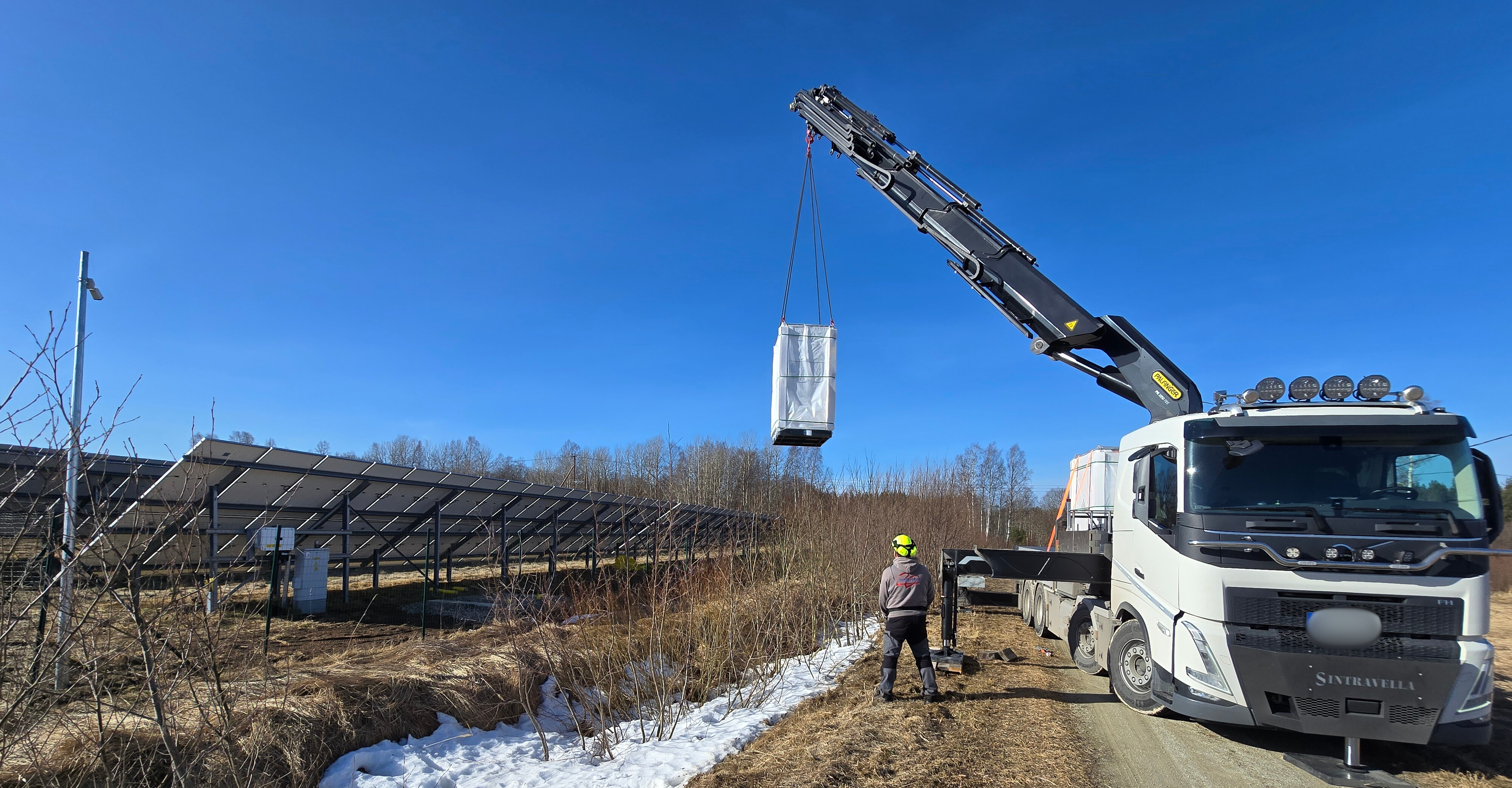
No additional PV capacity was installed. The expansion centered on integrating battery storage into the existing infrastructure.
Battery Energy Storage System (BESS):
• Technology: Sungrow PowerStack ST225kWh-110kW-2h
• Power capacity: 2 × 110 kW
• Energy capacity: 2 × 225 kWh (total 450 kWh)
• Primary functions:
o Load management
o Participation in ancillary services markets
The system enables temporal energy shifting solar energy can be stored during low-price periods and exported when market conditions are favorable. It also allows the site to provide grid balancing services.
5. IMPLEMENTATION
The site remained fully operational during installation.
Installation was completed in Q1 2026:
• Installation: 2 days
• Commissioning: 1 day
The only delay occurred was due to unsuitable weather conditions. Permitting was already secured together with the previously secured PV building permit.
Execution followed RMEnergy’s standard turnkey process model, from design and installation to setup and testing.
6. RESULTS AND IMPACT
As the system was recently commissioned, quantitative financial results are not yet available.
However, immediate qualitative outcomes include:
• Improved operational flexibility
• Creation of additional revenue streams via ancillary services
• Resolution of previous technical export limitations
• Increased delivery of renewable energy to the grid from the same PV installation
• Reduced operational risk exposure
The project converted a constrained solar park into an active market participant capable of responding to price signals and frequency regulation demand.
7. STRATEGIC VALUE
The integration of BESS transformed the business model of the PV site from passive energy exporter to active market participant
Instead of being fully exposed to price volatility, the client now operates with flexibility and revenue diversification. The project supports sustainability goals while improving economic performance.
The client emphasized that early design decisions during the original PV development enabled seamless BESS integration years later. As the same engineering partner delivered both phases, system architecture and grid connection were already prepared for expansion, reducing retrofit complexity and supporting stronger lifecycle profitability
8. CONCLUSION
This project demonstrates that energy infrastructure should be engineered with expansion logic built in from the start. Designing PV systems with grid capacity, technical architecture and future flexibility in mind enables later integration of storage without structural redesign. That approach protects capital, reduces retrofit risk and strengthens long-term project profitability.